
RESISTANCE BANDS – strength, mobility and stability
- By PROGRAMI MRŠAVLJENJA
- In TRAINING
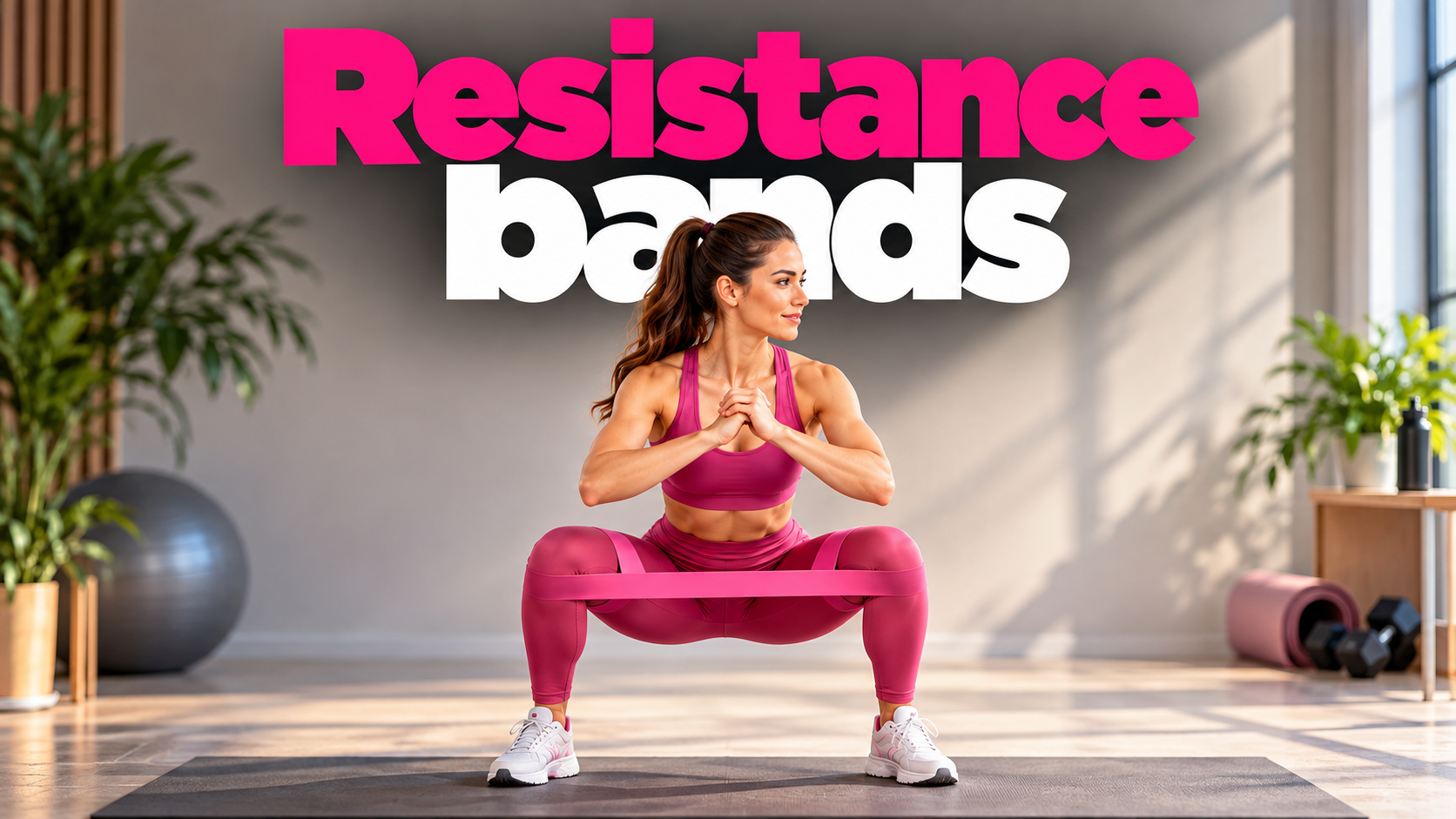
Resistance bands are versatile fitness tools used for strength training, muscle activation, mobility exercises, and rehabilitation programs. Unlike traditional free weights, resistance bands provide elastic resistance that generally increases as the band stretches. This allows users to perform controlled movements while engaging different muscle groups. Available in various resistance levels, lengths, and designs, these exercise accessories can be incorporated into workouts for beginners, experienced athletes, and individuals following professionally supervised rehabilitation programs.
One of the main advantages of resistance band training is the ability to adjust exercise intensity according to individual strength, fitness level, and training goals. Resistance can be modified by selecting a different band, changing its initial tension, or adjusting the range of motion. Strength training with resistance bands can help improve muscular strength and endurance when exercises are performed with appropriate technique and progressive overload. Bands are particularly useful for targeting the upper body, lower body, and core muscles through a wide variety of functional movements.
Another important benefit of resistance bands for exercise is their portability and adaptability to different training environments. They can be used at home, in fitness centers, or during outdoor workouts without requiring large exercise equipment. Depending on the type of band and exercise selection, full-body resistance band workouts may include squats, rows, shoulder exercises, hip strengthening, and controlled mobility movements. Choosing suitable resistance, maintaining proper body alignment, and regularly inspecting the material for damage are essential for safe and effective resistance training.
RESISTANCE LEVELS...
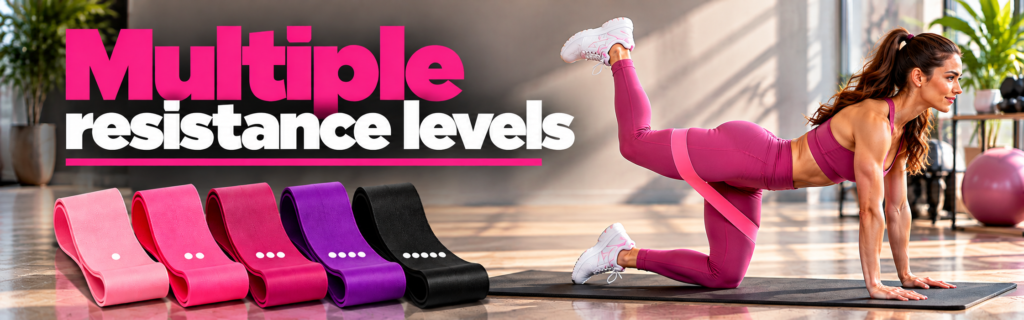
The resistance level of resistance bands plays an important role in determining exercise intensity, muscle activation, and overall training effectiveness. As the resistance increases, muscles must generate greater force to perform and control the movement. Selecting the appropriate resistance band strength allows individuals to adjust their workouts according to their physical abilities, training experience, and specific fitness goals. Lower resistance may be suitable for learning movement patterns, improving muscular endurance, or performing certain rehabilitation exercises, while higher resistance can provide a greater challenge during strength training.
Choosing the correct resistance level is also essential for maintaining proper exercise technique and achieving progressive improvements in muscular performance. Resistance that is too high may compromise movement control, reduce the available range of motion, or encourage compensatory movements. Conversely, insufficient resistance may not provide an adequate stimulus for the intended training adaptation. Progressive resistance training with resistance bands involves gradually increasing exercise demands as strength and muscular endurance improve. This progression can be achieved by adjusting band tension, selecting stronger bands, or modifying exercise difficulty while maintaining controlled and technically correct movements.
Types of resistance levels and their uses
◆ Extra light resistance: Designed for gentle muscle activation, mobility exercises, and controlled movements. Often used by beginners, older adults, or individuals participating in rehabilitation programs under professional supervision.
◆ Light resistance: Suitable for beginners developing muscular endurance, coordination, and exercise technique. Commonly used for warm-up routines, shoulder stabilization, and low-intensity strength exercises.
◆ Medium resistance: Appropriate for individuals with basic strength training experience. Provides moderate muscular loading during resistance band exercises, including squats, rows, hip strengthening, and upper-body workouts.
◆ Heavy resistance: Intended for individuals with greater muscular strength and training experience. Useful for more demanding strength training exercises targeting major muscle groups, particularly the legs, glutes, and back.
◆ Extra heavy resistance: Suitable for experienced individuals requiring higher levels of muscular loading. Commonly incorporated into advanced resistance band training and progressive strength programs when proper movement control can be maintained.
◆ Variable resistance: Resistance changes according to band elongation, initial tension, and material properties. Different resistance levels allow users to adjust exercise difficulty and progressively increase muscular demands.
HIGH-QUALITY ELASTIC MATERIAL
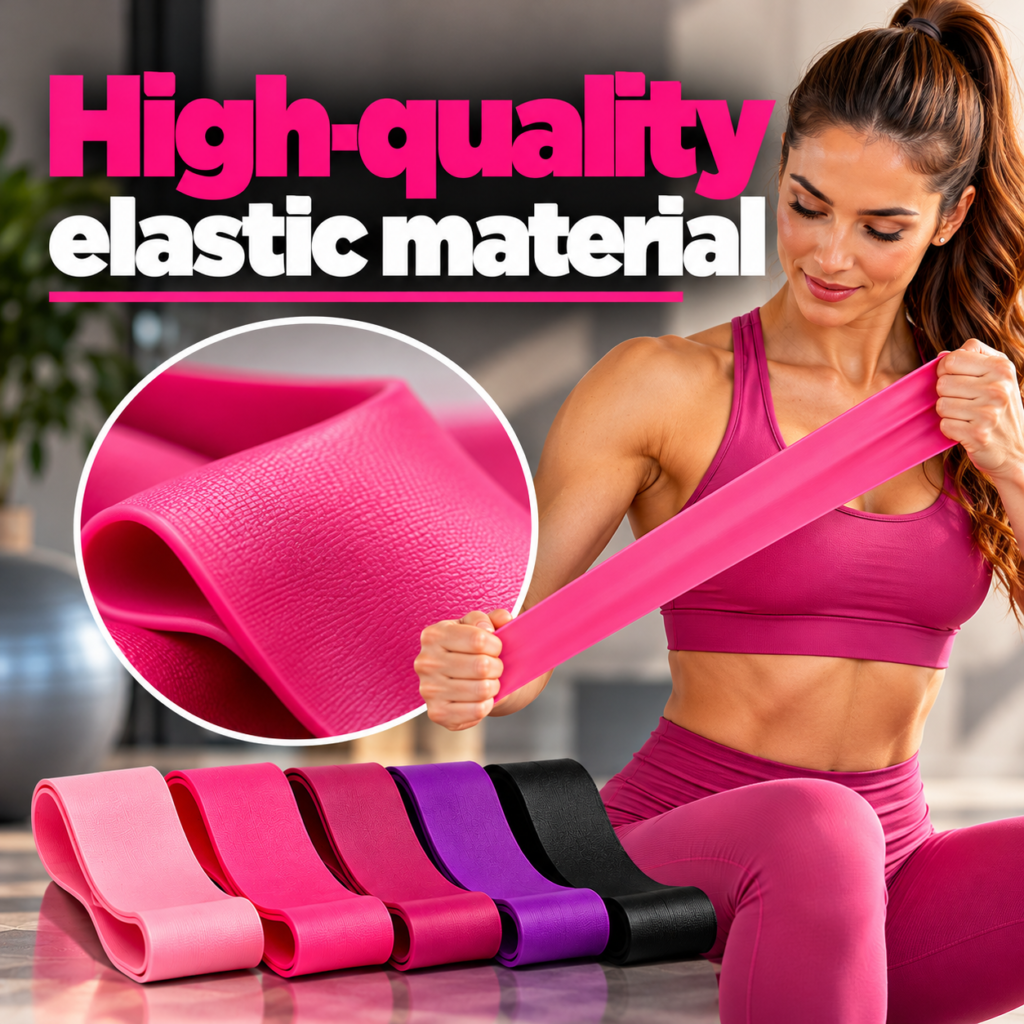
The quality of elastic material in resistance bands directly influences their performance, flexibility, durability, and ability to provide consistent resistance during exercise. High-quality resistance bands are commonly manufactured from natural latex, synthetic rubber, or specialized elastic fabrics, depending on their intended application. These materials have different mechanical properties that affect elasticity, stretching capacity, and resistance characteristics. A well-designed elastic band should provide predictable tension throughout its specified working range, allowing users to perform controlled movements and maintain appropriate muscular loading during strength training and resistance exercises.
Another important characteristic of high–quality resistance band materials is their ability to withstand repeated stretching while maintaining functional elasticity over time. Material composition, manufacturing quality, thickness, and environmental conditions can influence resistance consistency and product lifespan. Bands made from suitable materials can support a wide range of exercises, including muscle strengthening, mobility training, and rehabilitation exercises. However, even premium elastic materials may deteriorate with prolonged use, excessive stretching, heat exposure, or improper storage. Regular inspection for cracks, tears, surface damage, and changes in elasticity is essential to maintain safe and effective resistance band training.
Key characteristics of high-quality elastic material
◆ High elasticity and flexibility
◆ Consistent resistance during stretching
◆ Good elastic recovery
◆ Resistance to repeated stretching
◆ Durable material structure
◆ Smooth and comfortable surface
◆ Resistance to premature deformation
◆ Suitable thickness and material density
◆ Latex and latex-free material options
◆ Long-lasting performance with proper care
DURABLE AND TEAR-RESISTANT DESIGN
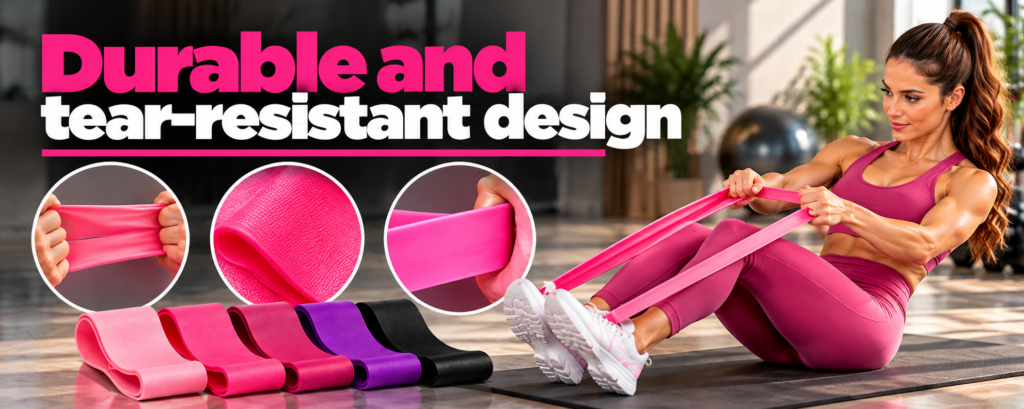
The durability of resistance bands is an essential factor in maintaining consistent performance, exercise safety, and long-term usability. High-quality resistance bands are designed to withstand repeated stretching and mechanical stress during different types of strength training. Their resistance to tearing depends on several factors, including material composition, thickness, manufacturing processes, and structural integrity. A well-constructed band should tolerate repeated loading within its recommended stretching limits without developing premature cracks, surface damage, or significant loss of elasticity. These characteristics are particularly important for individuals who regularly incorporate resistance band exercises into their fitness routines.
A tear-resistant design contributes to the reliability of exercise equipment by reducing the likelihood of material failure under appropriate operating conditions. Natural latex, synthetic rubber, and reinforced elastic fabrics offer different levels of mechanical strength, flexibility, and resistance to wear. The quality of material processing and the absence of manufacturing defects also influence overall product durability. During strength training with resistance bands, repeated stretching, friction against rough surfaces, and excessive tension can gradually weaken the material. Choosing bands with suitable construction and clearly defined resistance specifications helps support controlled movements and reliable performance.
Factors that influence resistance band durability
The lifespan of resistance bands depends not only on manufacturing quality but also on how frequently and intensively they are used. Repeated exposure to excessive stretching, sharp edges, direct sunlight, and high temperatures may accelerate material deterioration. Proper storage in a cool, dry environment and avoiding contact with abrasive surfaces can help preserve elastic resistance and structural integrity. Users should also consider the design of attachment points, handles, and connecting components, particularly when using resistance tubes with accessories. These elements must be sufficiently durable to withstand the forces generated during exercise.
Regular maintenance and visual inspection are important aspects of safe resistance band training. Before each workout, bands should be checked for visible cracks, cuts, thinning, fraying, damaged seams, or weakened attachment points. Any band showing signs of deterioration should be replaced rather than repaired or continued in use. Following the manufacturer’s recommendations regarding maximum elongation, appropriate resistance levels, and correct anchoring techniques can help reduce the risk of sudden breakage. Combining durable resistance band materials with proper handling and controlled exercise technique supports safer training and helps maintain equipment performance over time.
OPTIMAL LENGTH AND FLEXIBILITY
Types of resistance bands by length and flexibility
◆ Short loop bands: Suitable for hip activation, glute strengthening, and lower-body exercises with shorter movement ranges.
◆ Long loop bands: Ideal for full-body strength training, assisted pull-ups, stretching, and exercises requiring greater movement amplitude.
◆ Flat therapy bands: Available in different lengths and resistance levels, commonly used for controlled strengthening and rehabilitation exercises.
◆ Resistance tubes: Flexible tubular bands, often equipped with handles, suitable for upper-body and lower-body strength exercises.
◆ Fabric resistance bands: Typically designed for lower-body exercises, offering limited stretch and a more stable fit during movement.
◆ Adjustable–length bands: Allow users to modify the effective working length and initial tension according to exercise requirements and individual needs.
The length and flexibility of resistance bands are important factors that influence exercise performance, movement range, and training versatility. Different band lengths allow users to perform a variety of exercises targeting specific muscle groups while accommodating individual body dimensions and movement patterns. Longer resistance bands are often suitable for full-body exercises, standing movements, and exercises requiring greater distances between attachment points. Shorter bands, including loop bands, are commonly used for hip strengthening, lower-body activation, and controlled resistance exercises. Selecting an appropriate band length helps maintain effective tension without unnecessarily restricting natural movement.
The flexibility of resistance bands determines how effectively the material stretches and adapts to different exercise positions. Elastic properties influence the relationship between band elongation and the resistance experienced throughout a movement. Bands with suitable flexibility can accommodate different ranges of motion while providing progressive elastic tension. During strength training with resistance bands, appropriate length and flexibility help users perform exercises with controlled technique and suitable muscular loading. However, excessive stretching beyond the manufacturer’s recommended limits may damage the material and increase the risk of breakage. Choosing bands according to exercise requirements, body dimensions, and resistance specifications supports safer and more effective training.
PROGRESSIVE RESISTANCE TRAINING
Progressive resistance training with resistance bands is an effective method for gradually increasing muscular demands and supporting improvements in strength, endurance, and physical performance. The principle of progressive overload involves systematically adjusting training intensity, volume, or exercise difficulty as the body adapts to previous workloads. With resistance bands, progression can be achieved by selecting bands with greater resistance, increasing initial band tension, modifying exercise positions, or adjusting repetitions and sets. These changes allow individuals to challenge different muscle groups while maintaining controlled movements and appropriate exercise technique. Progressive training should be adapted to individual fitness levels, recovery capacity, and specific training objectives.
An important advantage of resistance band training is the ability to modify exercise difficulty without relying exclusively on traditional weights or large fitness equipment. As muscular strength improves, resistance can be gradually increased to provide an appropriate training stimulus and support continued adaptation. However, effective progressive strength training requires more than simply choosing a stronger band. Exercise selection, movement range, repetition speed, training frequency, and recovery periods also influence results. Increasing resistance too quickly may compromise technique and contribute to excessive muscular or joint stress. A structured approach to progressive resistance exercises helps improve muscular performance while supporting long-term training consistency and reducing avoidable injury risks.
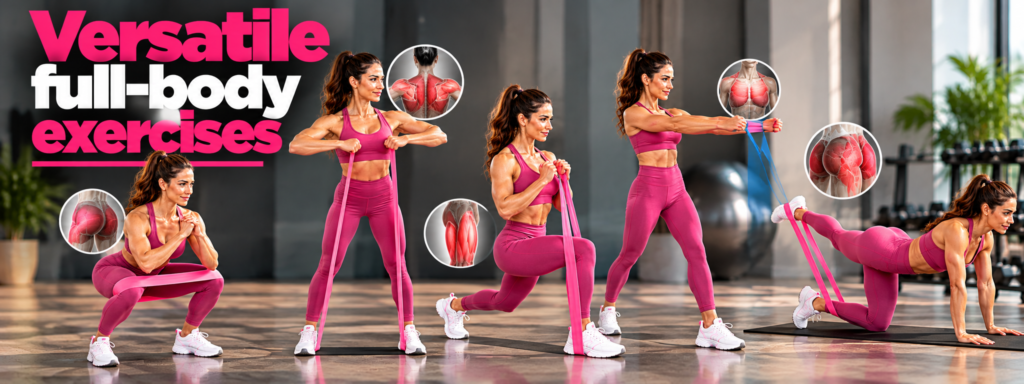
VERSATILE FULL BODY EXCERCISES
Resistance bands provide a versatile approach to full–body training by allowing users to target multiple muscle groups through a wide range of controlled movements. Unlike equipment designed for a limited number of exercises, resistance bands for full-body workouts can be incorporated into upper-body, lower-body, and core strengthening routines. Exercises such as squats, rows, chest presses, shoulder movements, and hip extensions can be adapted to different resistance levels and individual fitness abilities. The elastic resistance generated during stretching creates muscular demands that vary throughout the movement, depending on band tension, exercise position, and joint mechanics. This adaptability makes resistance band exercises suitable for home workouts, fitness centers, and professionally supervised rehabilitation programs.
Another important advantage of full–body resistance band training is the ability to combine strength development, muscular endurance, coordination, and movement control within a structured exercise program. Different band types and attachment positions allow users to perform exercises in standing, seated, or lying positions, making training adaptable to various physical abilities and functional goals. Resistance band workouts can include both isolated movements targeting specific muscles and compound exercises involving several muscle groups simultaneously. To achieve effective results, exercise selection should consider appropriate resistance, movement technique, training volume, and progressive overload. A balanced full-body strength training program should address major muscle groups while allowing sufficient recovery between demanding training sessions..
SAFE AND PROPER USE
The safe and proper use of resistance bands is essential for preventing avoidable injuries, maintaining exercise effectiveness, and preserving equipment durability. Although resistance bands are versatile and suitable for different fitness levels, improper handling, excessive stretching, or incorrect exercise technique may increase the risk of injury. Selecting an appropriate resistance level, maintaining controlled movements, and following the manufacturer’s instructions are important aspects of safe resistance band training. Particular attention should be given to band condition, secure attachment points, body alignment, and gradual progression during strength exercises.
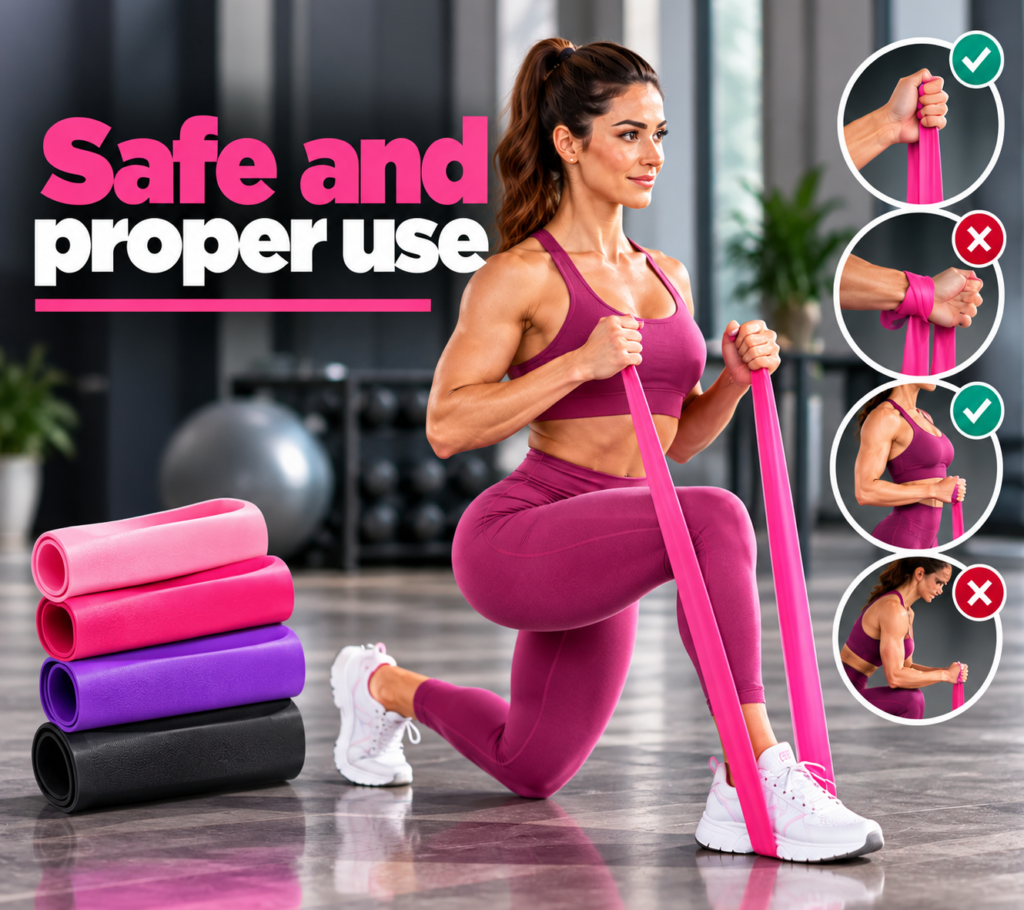
Essential safety guidelines for resistance band training
◆ Choose appropriate resistance: Select a band that matches your strength, fitness level, and exercise requirements.
◆ Inspect bands before use: Check for cracks, tears, thinning, or other visible signs of material damage.
◆ Maintain proper technique: Perform exercises with controlled movements and correct body alignment.
◆ Secure attachment points: Ensure that anchors, handles, and connecting components are stable and properly installed.
◆ Avoid excessive stretching: Never extend bands beyond the manufacturer’s recommended limits.
◆ Control movement speed: Avoid sudden pulling, uncontrolled release, and rapid movements that compromise stability.
◆ Protect your face and eyes: Keep bands away from the face and avoid positions where accidental release could cause injury.
◆ Increase resistance gradually: Apply progressive overload according to individual strength and training experience.
◆ Allow adequate recovery: Balance training intensity and frequency with sufficient muscular recovery.
◆ Follow manufacturer guidelines: Respect recommended resistance ranges, usage instructions, and equipment limitations.
Important considerations for safe and effective training
Although resistance bands are valuable tools for strength training, muscle activation, and rehabilitation exercises, they are not a substitute for professional medical assessment, individualized rehabilitation, or comprehensive physical activity programs. Individuals experiencing persistent pain, joint instability, or musculoskeletal injuries should seek appropriate professional guidance before beginning or modifying their exercise routines. Resistance band training should be adapted to individual physical abilities, health conditions, and specific training goals rather than following the same intensity and exercise selection for everyone.
For optimal results, resistance band exercises should be incorporated into a balanced training program that includes appropriate strength development, mobility, cardiovascular activity, and sufficient recovery. Particular attention should be given to proper exercise technique, progressive overload, resistance selection, and equipment safety. Training should not continue through sharp or worsening pain, and damaged bands should never be used. Consistency, gradual progression, and appropriate exercise selection are more important than using the highest possible resistance.
- Share:

You may also like

STRETCHING – 5 minutes for your health..
- November 9, 2026
- by PROGRAMI MRŠAVLJENJA
- in HEALTH

RESISTANCE TRAINING – why is it my choice…